
EURUSD
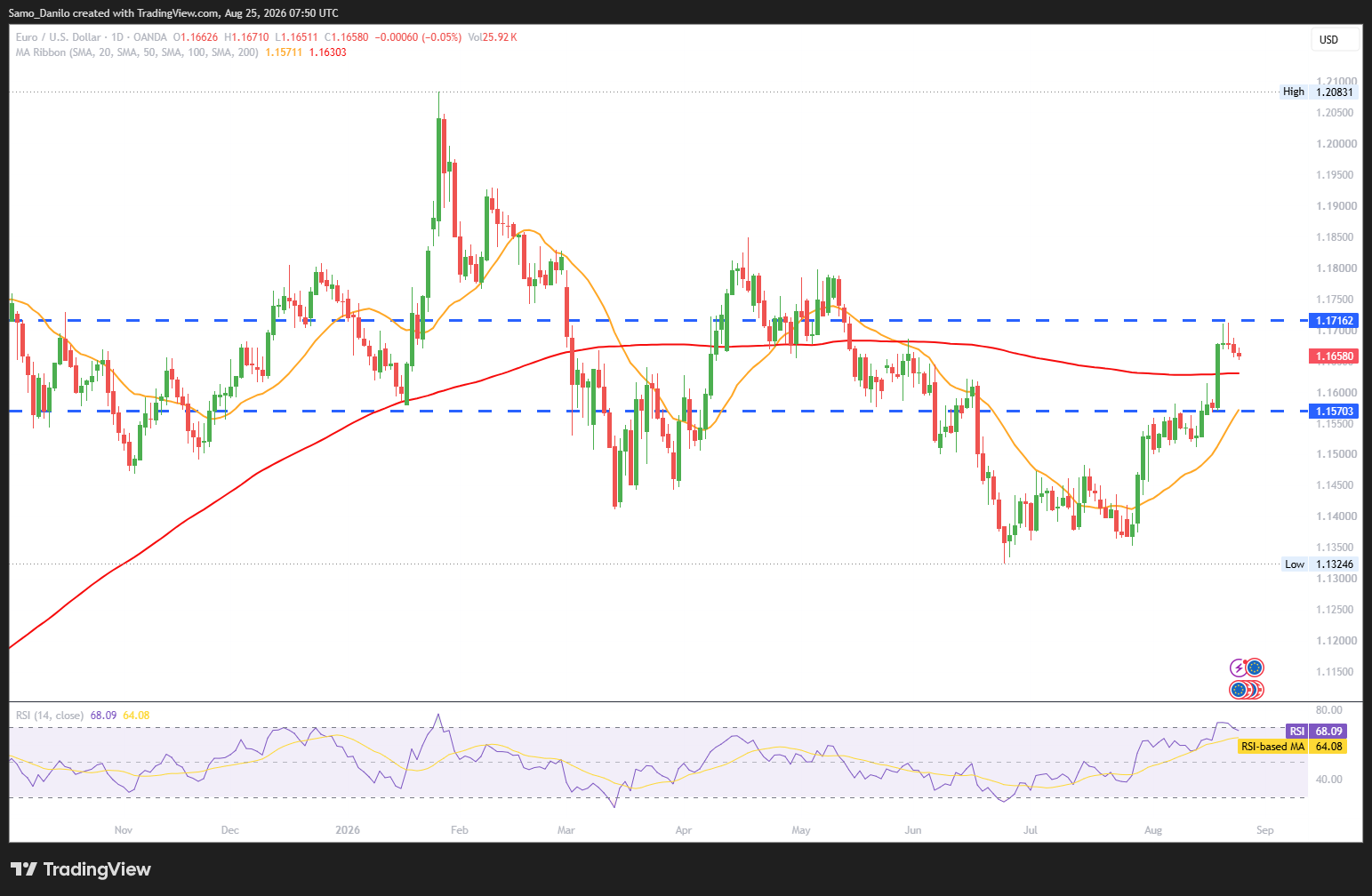
- EUR/USD Price: EUR/USD is edging higher around 1.1670 in Asian trading after recording modest losses in the previous session.
- Hawkish expectations: The euro continues to benefit from expectations that the ECB will deliver another 25-basis-point rate hike in September, following its June tightening.
- Treasury policy: The dollar is being pressured by the US Treasury's decision to double its buyback operations for longer-dated government bonds. Reports that Treasury Secretary Scott Bessent could potentially use close to $1 trillion from the Treasury General Account add to expectations of significant Treasury market intervention, weighing on the dollar.
- Iran-Pakistan: Monday's discussions between Iran and Pakistan included the possibility of restoring the Islamabad MOU as part of efforts to resolve the US-Iran conflict.
- US-Iran tensions: President Trump reiterated his aggressive stance toward Iran, saying the US is "beating Iran very badly" while again stressing that Tehran cannot possess a nuclear weapon.
| SMA (20) | Rising |  | |
| RSI (14) | Rising | | |
| MACD (12, 26, 9) | Rising | | |
Closing statement: EUR/USD retains a bullish near-term bias, supported by expectations of further ECB tightening and weakness in the US Dollar. However, renewed escalation in US-Iran tensions could trigger safe-haven dollar demand and temporarily cap gains around current levels.
GBPUSD
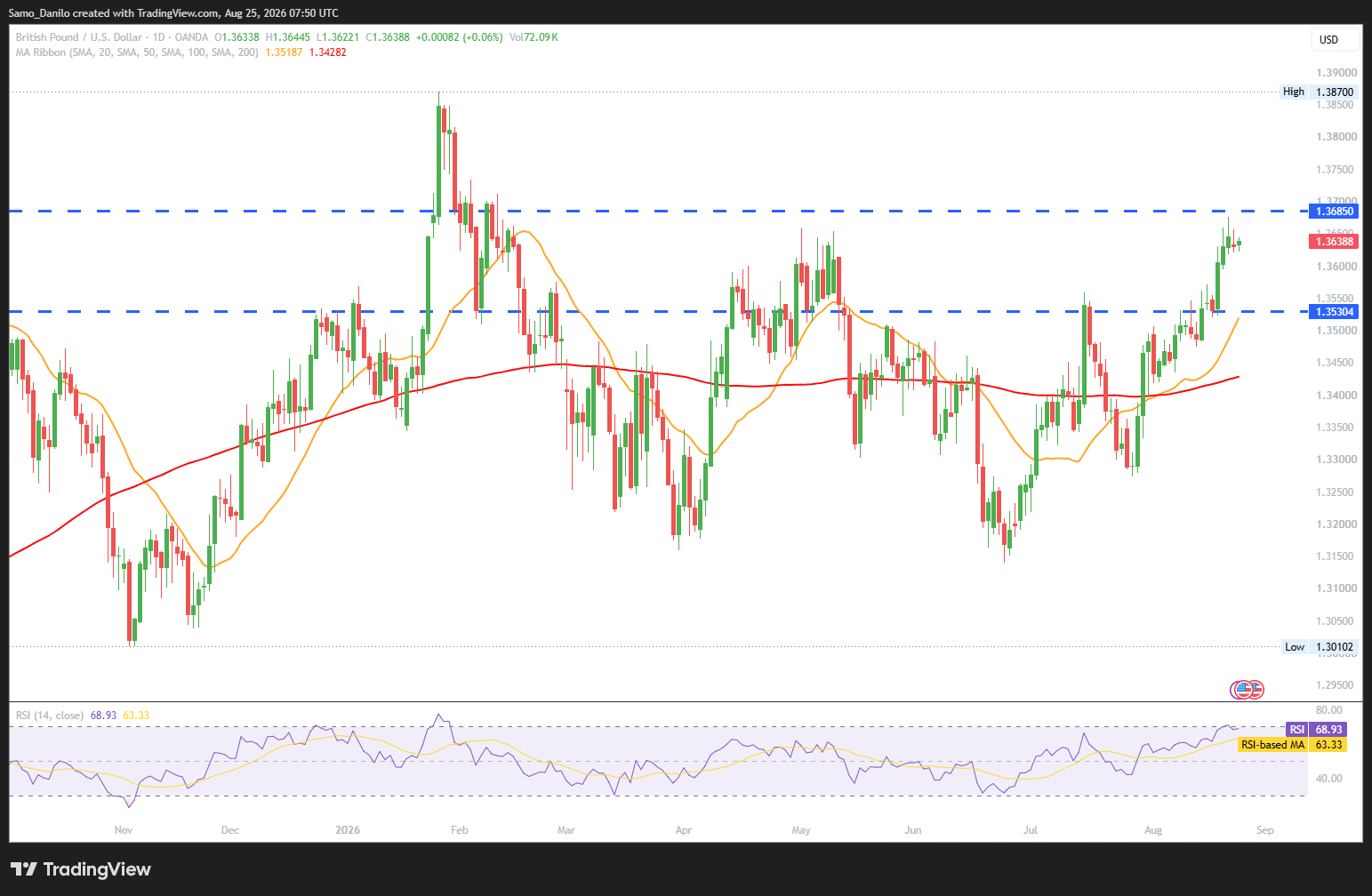
- GBP/USD Price: GBP/USD continues to move sideways for a second consecutive day, trading around 1.3630 during the Asian session.
- US sanctions: The US Treasury has expanded secondary sanctions targeting Iran's digital assets, technology, gold, aviation and shipping sectors, threatening entities that facilitate economic activity with Iran with exclusion from the US dollar system.
- Ukraine developments: UK Prime Minister Burnham indicated that European leaders could meet around the UN General Assembly to discuss Ukraine, while also describing Ukraine's shortage of air-defense interceptors as manageable.
- Consumer confidence: The Conference Board's August consumer confidence report is due later today, with the index having fallen to 90.8 in July and gradually weakening over recent years.
- Jackson Hole: Fed Chair Kevin Warsh is scheduled to speak at the Jackson Hole symposium on Friday, making his comments one of the week's most important catalysts for GBP/USD.
| SMA (20) | Rising | | |
| RSI (14) | Rising | | |
| MACD (12, 26, 9) | Rising | | |
Closing statement: GBP/USD maintains a neutral-to-mildly bullish bias while holding around 1.3630, but the pair remains vulnerable to renewed dollar strength from geopolitical tensions or strong US data. The key directional catalyst is likely to come later in the week from Fed Chair Warsh's Jackson Hole speech.
XAUUSD
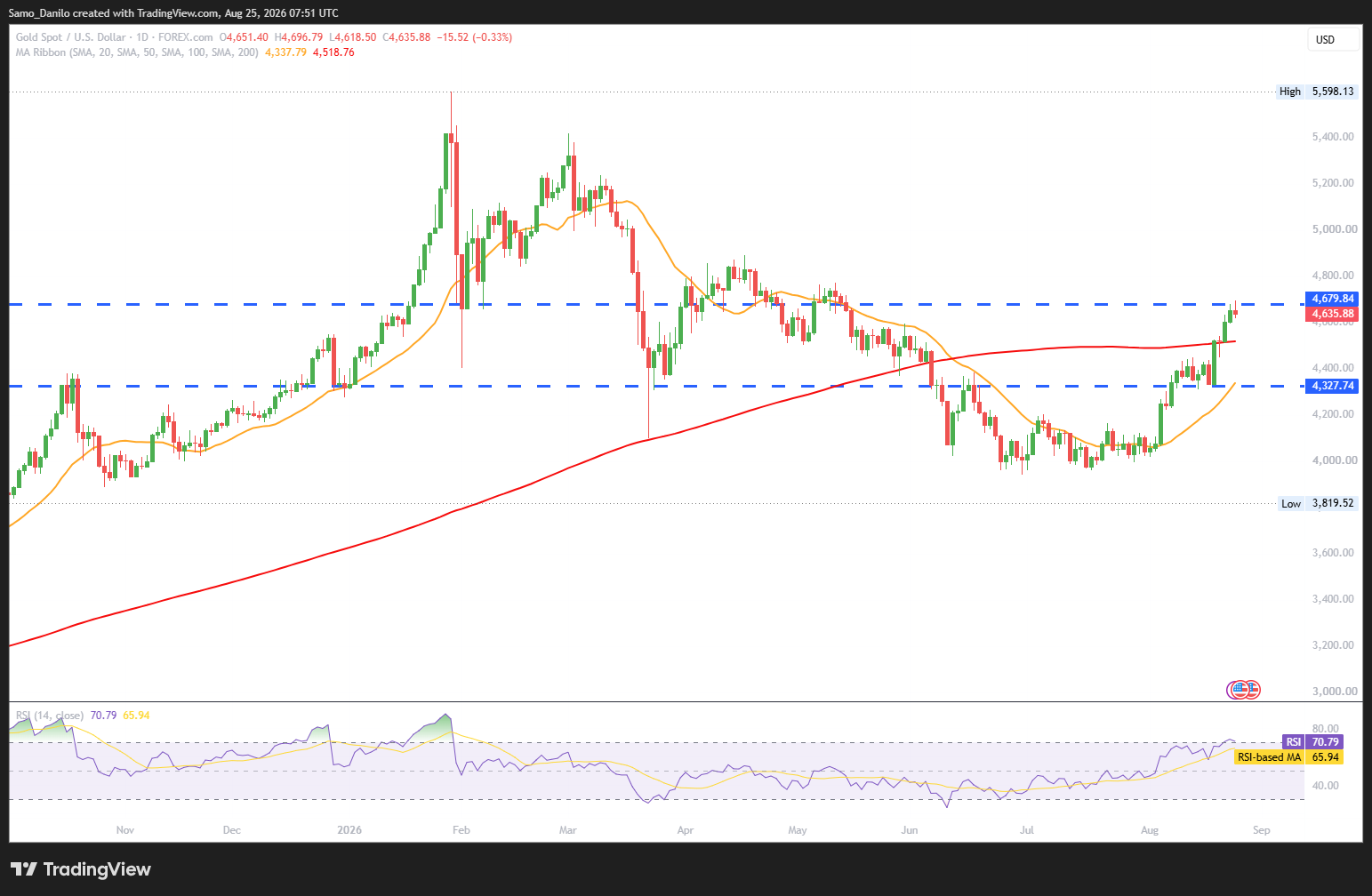
- XAU/USD Price: Gold touched a new high since May 14 during Tuesday's Asian session but struggled to sustain the move and remained below the psychologically important $4,700 level.
- Trade tensions: Canada is expected to announce retaliatory tariffs against the US after Washington announced new 50% tariffs on Canadian autos, auto parts and steel.
- US-China trade: US Trade Representative Jamieson Greer indicated that Washington is increasingly focused on protecting the US market rather than attempting to change China's economic model.
- Fed rate: Markets continue to price in a more than 75% probability of at least one Fed rate hike by year-end, with inflation risks linked partly to volatile crude oil prices.
- Apple news: Apple is reportedly considering price increases of around $100 for some upcoming iPhone models while expanding its home-device strategy.
| SMA (20) | Rising | | |
| RSI (14) | Rising | | |
| MACD (12, 26, 9) | Rising | | |
Closing statement: Gold maintains a bullish underlying bias, supported by trade tensions and elevated geopolitical uncertainty, but the inability to break $4,700 and still-high Fed rate-hike expectations create important resistance.
CRUDE OIL
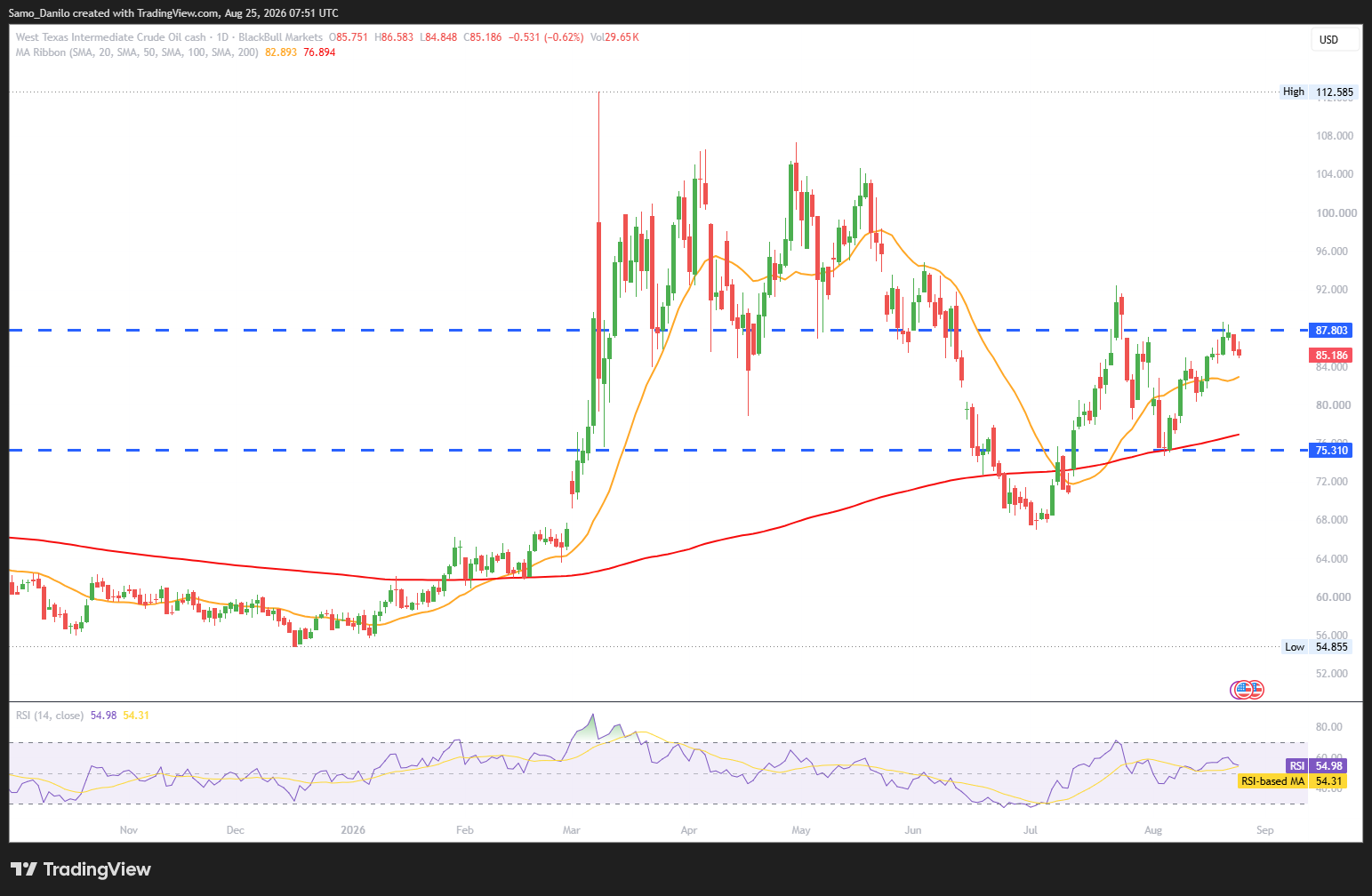
- Crude Oil Price: WTI is trimming some of its recent advance and trades around $85.00 on Tuesday.
- Reserve release: IEA chief Fatih Birol confirmed that there are currently no discussions regarding a second release from strategic oil reserves.
- Ukraine-Russia: President Zelenskiy said Ukraine will seek talks with Vladimir Putin regarding grain exports, while noting that Ukrainian sea-based grain exports are not completely blocked by Russia.
- Russian oil: A fire was reported at the Afipsky oil refinery in Russia's Krasnodar region, creating a potential disruption to Russian refined-product supply.
- Venezuela oil: ExxonMobil and ConocoPhillips remain reluctant to return to Venezuela as negotiations have slowed over fiscal terms and concerns about political and legal stability.
| SMA (20) | Rising | | |
| RSI (14) | Rising | | |
| MACD (12, 26, 9) | Slightly Rising | |
Closing statement: WTI retains a bullish underlying bias despite Tuesday's pullback, with the absence of another strategic reserve release and potential Russian refinery disruptions providing support. However, the current consolidation around $85 suggests traders may be taking profits, leaving further upside dependent on fresh supply disruptions or geopolitical developments.
DAX
- DAX 40 Price: Germany's benchmark DAX 40 is trading higher around 26,220 points this morning.
- Business sentiment: Scotiabank strategists note that fundamental releases have been relatively limited, making the German IFO business sentiment figures one of the week's most important events.
- German Bunds: German Finance Minister Lars Klingbeil attributed the recent increase in bond yields to the impact of the US-Iran conflict. Higher yields can create some pressure on equity valuations by increasing financing costs and the attractiveness of fixed-income assets, potentially limiting the DAX's upside.
- Rhine levels: Although the Rhine has recovered slightly from its record-low levels in mid-August, water levels remain extremely low at Kaub, an important shipping point.
- Volkswagen issues: Lower Saxony's Minister President Olaf Lies continues to oppose potential Volkswagen plant closures, arguing that reducing the group's size is not a sustainable solution. The comments highlight the ongoing challenges facing Germany's automotive industry, while CEO Oliver Blume's description of Volkswagen as "oversized" underscores the pressure to restructure and improve efficiency.
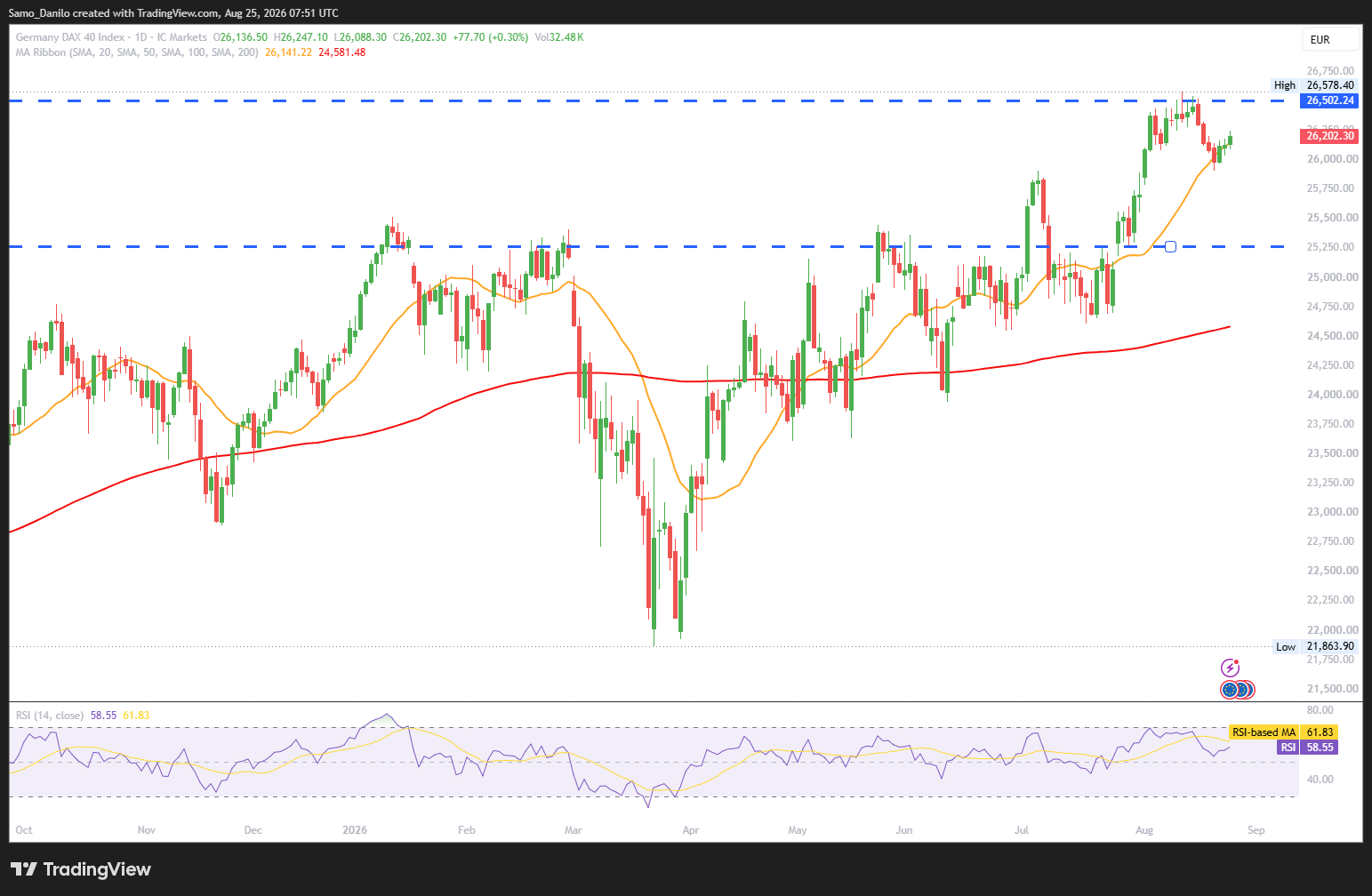
| SMA (20) | Rising | | |
| RSI (14) | Rising | | |
| MACD (12, 26, 9) | Slightly Rising | |
Closing statement: The DAX 40 maintains a moderately bullish tone, with limited macro news allowing the index to remain supported ahead of the IFO report. However, elevated bond yields, persistent Rhine logistics problems and structural weakness in the automotive sector could restrict further gains and increase volatility.