
EURUSD
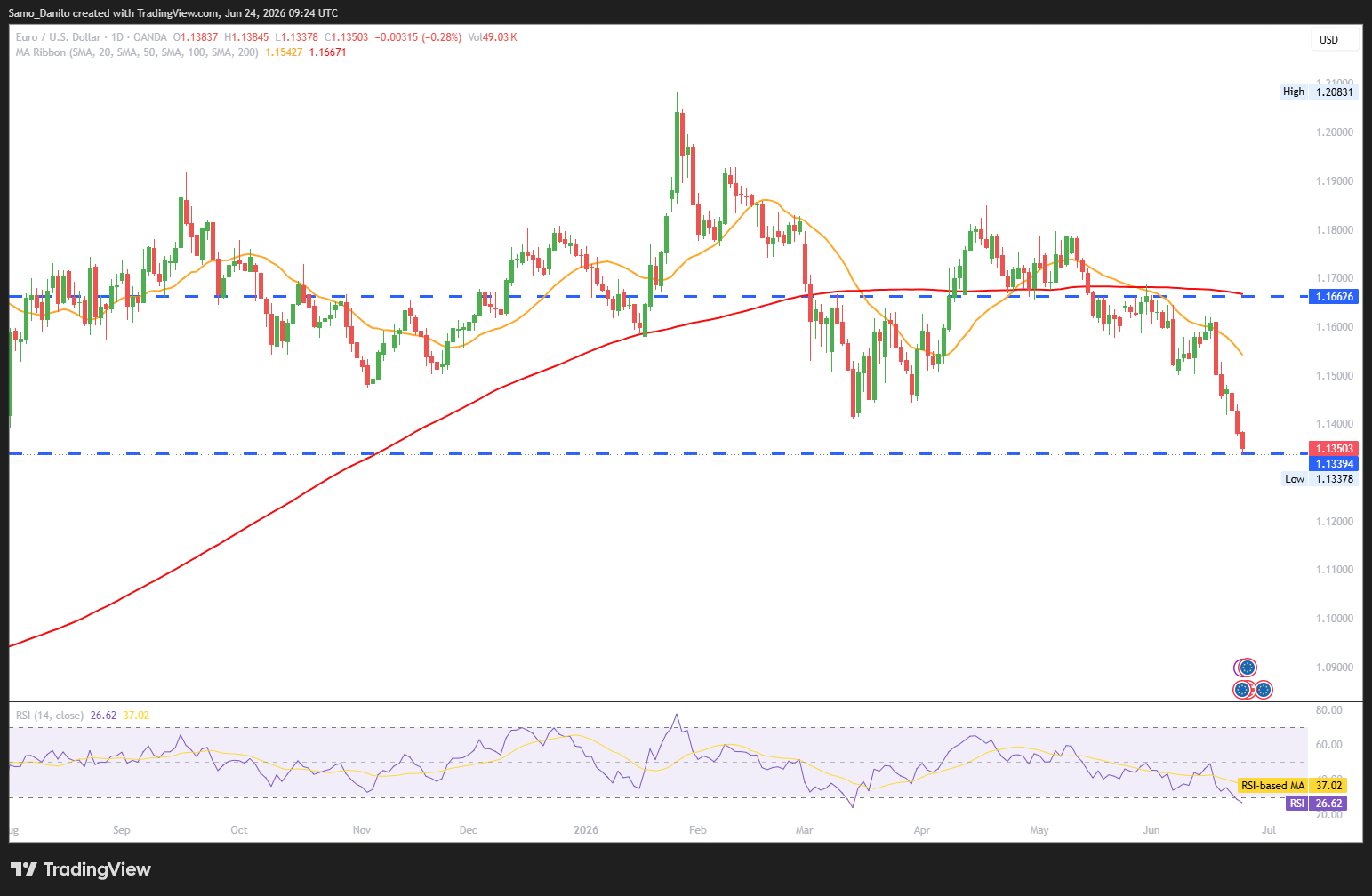
- EUR/USD Price: The EUR/USD pair continues its downward trend for a third consecutive session, falling to around 1.1370 during Wednesday's European trading. The sustained weakness reflects persistent demand for the US Dollar.
- PMI data: June's Eurozone PMI figures were generally stronger than expected, with the Composite PMI rising to 49.5 from 48.5. While manufacturing activity eased slightly below forecasts, the stronger-than-expected services reading suggests that business conditions are improving and that the region's economic slowdown may be moderating.
- US-Iran negotiations: President Donald Trump stated that Iran had agreed to allow nuclear inspections, pointing to potential diplomatic progress. However, Iran's Foreign Minister Abbas Araghchi rejected that characterization, saying formal negotiations on the nuclear issue have not yet begun, leaving markets uncertain about the prospects for a lasting agreement.
- Middle East: A new round of negotiations between Israel and Lebanon has begun in Washington with the aim of ending cross-border hostilities involving Hezbollah.
- Fed rate: Markets have further increased expectations that the Federal Reserve will raise interest rates before the end of the year to address persistent inflation.
| SMA (20) | Falling |  | |
| RSI (14) | Falling | | |
| MACD (12, 26, 9) | Falling | | |
Closing statement: EUR/USD remains under significant pressure as expectations of further Federal Reserve tightening and continued US Dollar strength outweigh improving Eurozone business activity. While stronger PMI data offer some support for the euro, the pair's near-term outlook remains bearish unless US monetary policy expectations soften or Eurozone economic momentum improves more decisively.
GBPUSD
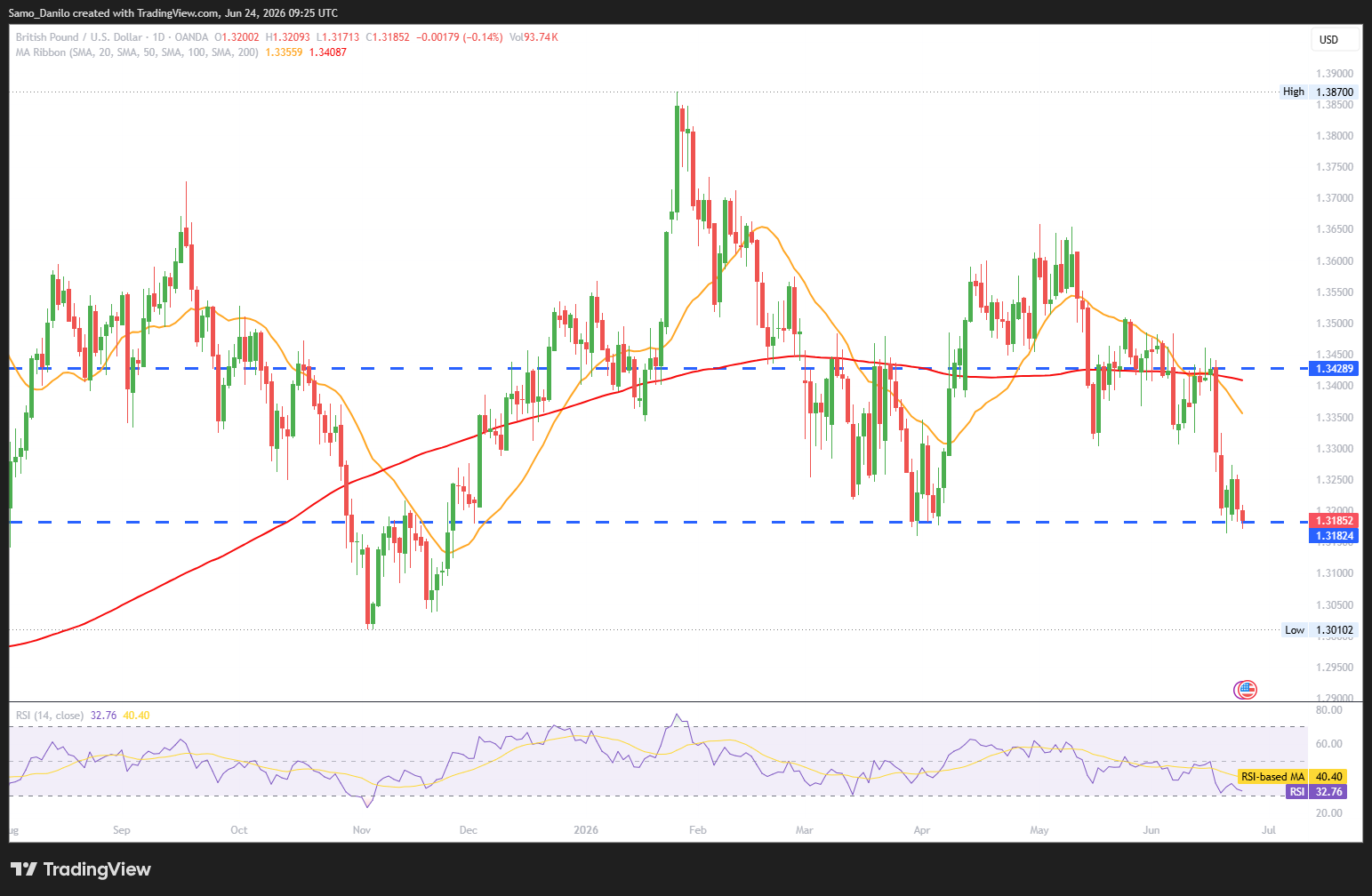
- GBP/USD Price: The GBP/USD pair is trading in a bearish consolidation phase during Wednesday's European session, holding near the 1.3200 level. The pair continues to struggle as strong demand for the US Dollar offsets any support for sterling, keeping downside pressure intact.
- PMI data: The latest UK PMI figures disappointed expectations, with the services sector contracting at its fastest pace in more than three years. As a result, the Composite PMI slipped to 49.4, remaining below the 50-point threshold that separates expansion from contraction, reinforcing concerns that the UK economy is losing momentum.
- Fed outlook: Last week's Federal Reserve meeting, chaired by Kevin Warsh, was interpreted as more hawkish than expected, leading markets to increase expectations for another interest rate hike before year-end.
- UK fiscal policy: Investors remain focused on the UK political landscape, particularly the fiscal policy stance of potential leadership candidate Andy Burnham. Any indication that fiscal rules could be relaxed may unsettle the UK bond market, increase borrowing costs, and place additional downward pressure on the pound.
- US PMI: US business activity exceeded expectations in June, with manufacturing PMI rising to 55.7, the strongest reading since 2022, and services PMI also improving.
| SMA (20) | Falling | | |
| RSI (14) | Falling | | |
| MACD (12, 26, 9) | Falling | | |
Closing statement: GBP/USD remains biased to the downside as weak UK economic data, political uncertainty, and expectations of further Federal Reserve tightening continue to favor the US Dollar. Unless UK economic indicators begin to improve or US monetary policy expectations soften, the pair is likely to remain under pressure in the near term.
XAUUSD
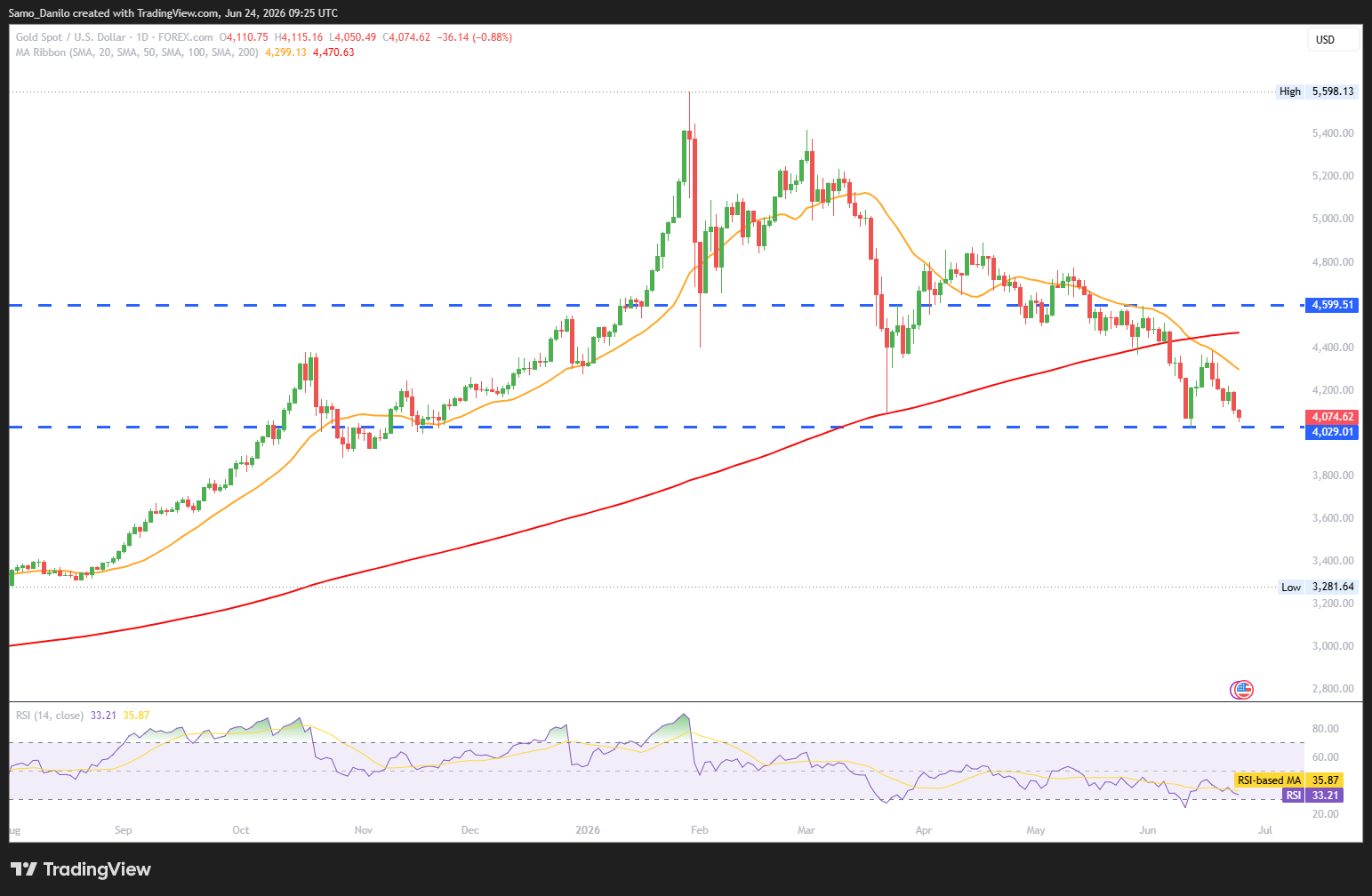
- XAU/USD Price: Gold has recovered during Wednesday's European session after falling to a nearly two-week low around $4,050.
- US political developments: The US Senate approved a war powers resolution aimed at limiting President Trump's ability to resume military action against Iran without Congressional approval. Although the resolution's legal impact remains uncertain, it signals growing bipartisan caution toward further military involvement, which could help reduce geopolitical tensions and moderate safe-haven demand for gold.
- Diplomatic progress: US Vice President JD Vance stated that Iran had agreed during peace talks in Switzerland to allow inspectors from the International Atomic Energy Agency (IAEA) access to its nuclear facilities.
- Fed outlook: Nine of the Federal Reserve's 19 policymakers indicated that additional interest rate hikes may be necessary to bring inflation under control. The relatively hawkish distribution of views reinforces expectations that US monetary policy could remain restrictive for longer, limiting the appeal of non-yielding assets such a gold.
- Rate expectations: Markets have sharply increased the probability of a 25-basis-point Federal Reserve rate hike in July to 37.4%, up from just 8.5% a week earlier.
| SMA (20) | Falling | | |
| RSI (14) | Falling | | |
| MACD (12, 26, 9) | Falling | | |
Closing statement: Gold is recovering from recent lows as investors cautiously respond to signs of easing geopolitical tensions and bargain-buying activity. However, increasingly hawkish Federal Reserve expectations remain the dominant market driver, suggesting that XAU/USD may struggle to sustain a broader recovery unless inflation data weaken or expectations for further US rate hikes begin to fade.
CRUDE OIL
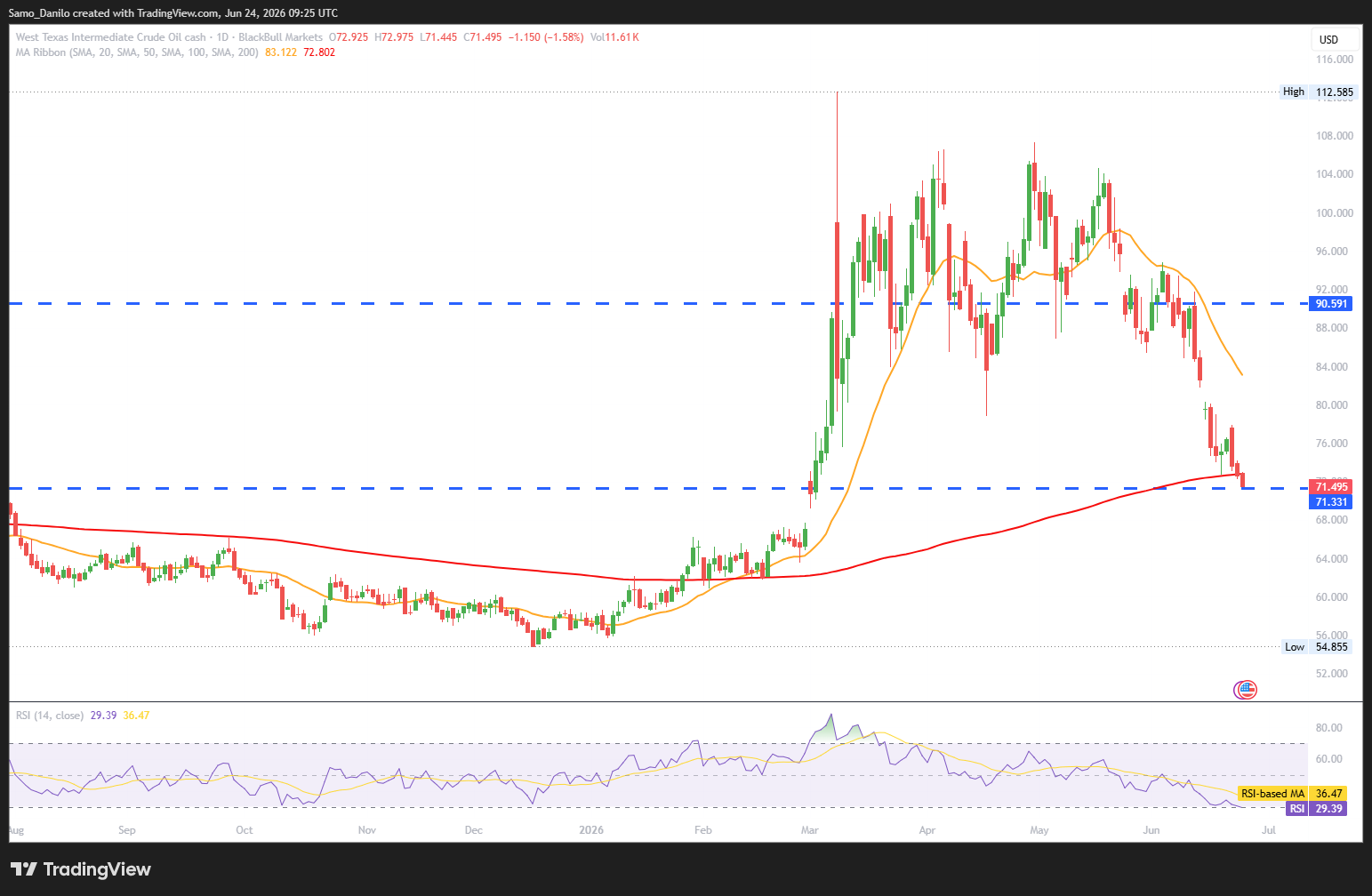
- Crude Oil Price: WTI crude oil continues its downward trend, falling below the $72 per barrel mark and reaching its lowest level since the escalation of the Iran-Israel conflict in late February.
- Strait of Hormuz: An Iranian military source indicated that a limited number of vessels are once again being allowed to transit the Strait of Hormuz under the supervision of Iran's Revolutionary Guards Navy. Although shipping remains restricted, the gradual reopening of this critical trade route has eased fears of a prolonged disruption to global oil exports and is weighing on crude prices.
- US sanctions: The US Treasury Department issued a temporary 60-day waiver allowing the production, delivery, and sale of Iranian crude oil, petroleum, and petrochemical products. The move could significantly increase the amount of Iranian oil reaching international markets in the near term.
- US administration: President Donald Trump criticized oil companies for keeping gasoline prices elevated despite lower crude oil costs and instructed the Department of Justice to investigate potential unfair commercial practices.
- US oil production: The US government announced plans to reduce regulatory burdens on oil and gas producers by simplifying leasing rules and easing waste prevention requirements on federal lands.
| SMA (20) | Falling | | |
| RSI (14) | Falling | | |
| MACD (12, 26, 9) | Falling | | |
Closing statement: WTI remains under significant downward pressure as geopolitical risks continue to ease, Iranian crude returns to global markets, and US policies increasingly favor higher energy production. With both international and domestic supply prospects improving, the near-term outlook remains bearish unless unexpected geopolitical disruptions or stronger-than-expected demand reverse the current market sentiment.
DAX
- DAX 40 Price: The DAX 40 slipped sharply below the 24,700-point level during Wednesday's European session, reflecting cautious investor sentiment.
- TKMS surge: Shares of TKMS jumped more than 11% after reports indicated that Germany's Defense Ministry plans to purchase eight Meko-200 frigates from the company instead of proceeding with the existing F126 frigate construction project. The potential defense contract significantly improves TKMS's business outlook and highlights continued government investment in military modernization.
- Rheinmetall falls: Rheinmetall shares fell as much as 13.6% after reports suggested the company could lose out on a major naval contract. Investors reacted negatively as the revised procurement strategy reduces expectations that Rheinmetall will secure a key role in the F126 frigate program, weighing heavily on one of Germany's leading defense stocks.
- Airbus orders: Airbus Helicopters delivered the first H145M military helicopter to Belgium, marking an important milestone in the country's defense modernization program. The delivery reinforces Airbus' strong presence in the European defense sector and reflects continued demand for advanced military equipment across the region.
- Business confidence: The IFO Business Climate Index rose to 85.6 in June from 85.0 in May, while the Current Assessment Index also exceeded expectations. The stronger-than-expected survey suggests that German businesses are becoming more optimistic about economic conditions, providing a positive signal for future corporate activity despite current market weakness.
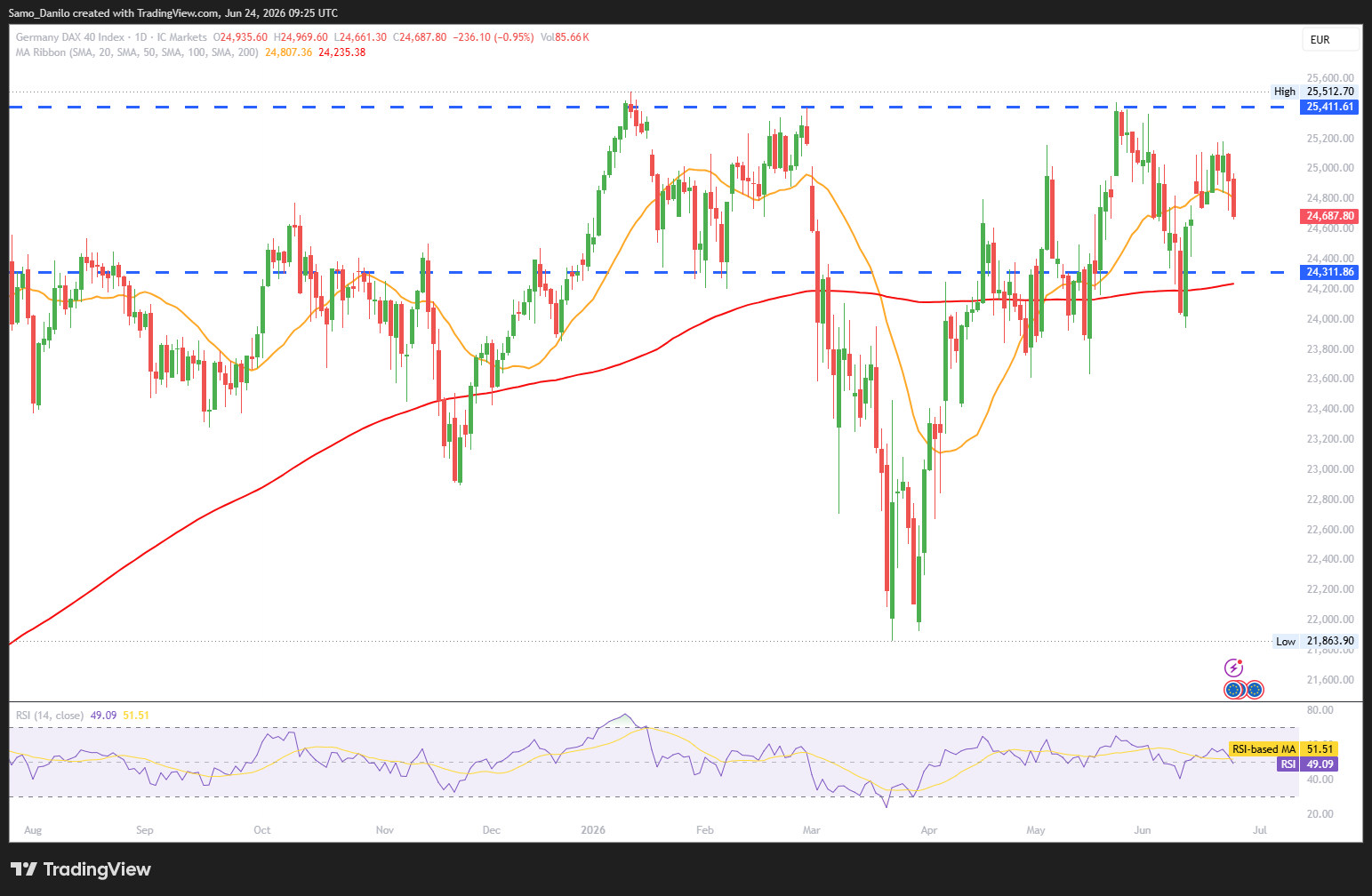
| SMA (20) | Slightly Rising |  |
| RSI (14) | Slightly Falling | |
| MACD (12, 26, 9) | Slightly Rising | |
Closing statement: The DAX remains under pressure as significant sector-specific weakness, particularly within defense stocks, offsets encouraging signs of improving business confidence in Germany. While stronger IFO data point to a gradually stabilizing economy, investor sentiment is likely to remain sensitive to corporate developments and broader global market conditions in the near term.